Chart tool
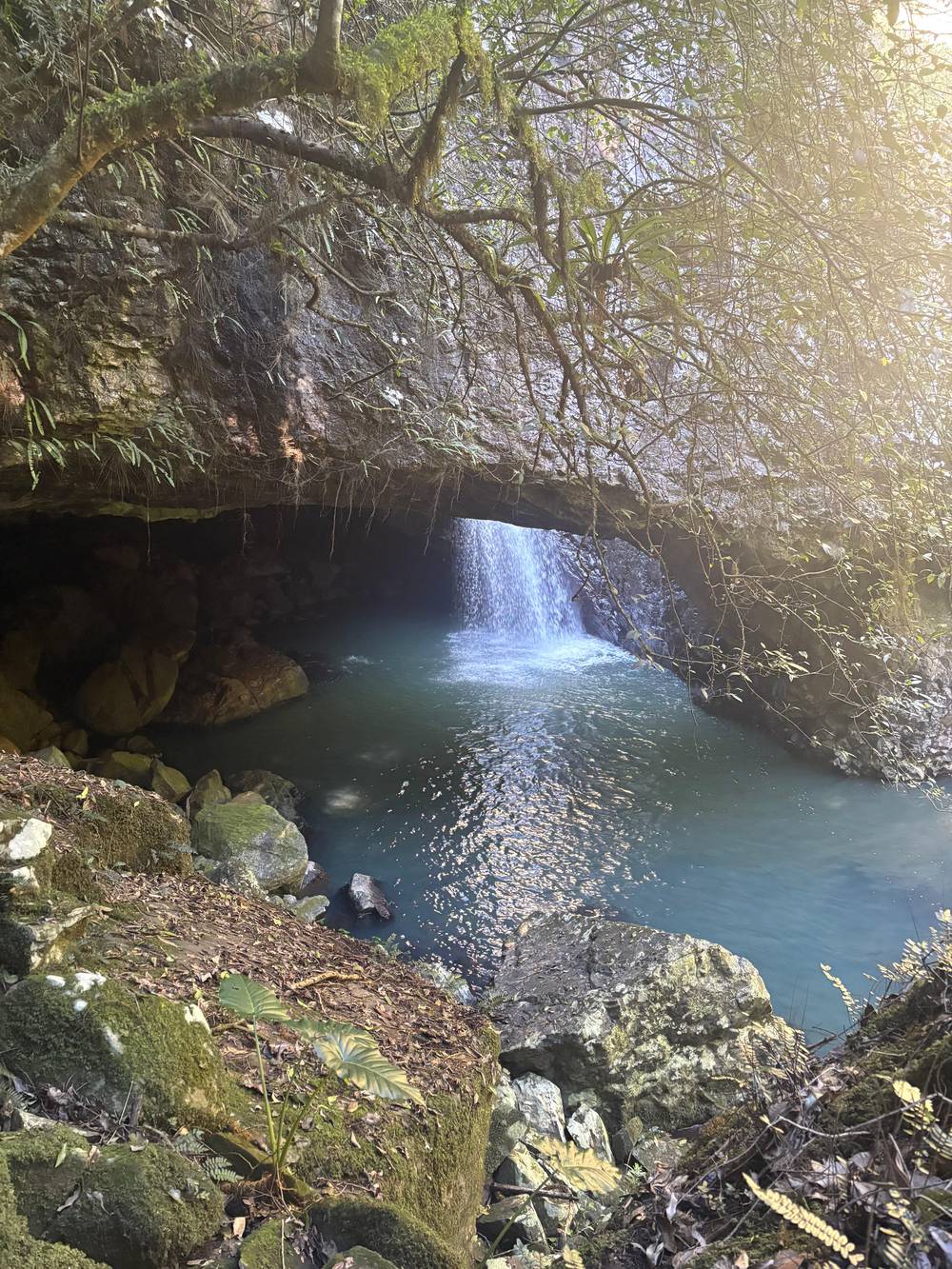
Springbrook National Park glow worms at the Natural Bridge
A year of glow
Sunset, darkness and the glow worm season
Choose a month to see when the sun sets over Springbrook and what that month means for the glow worms in the Natural Bridge cave.
Sunset
Jan
- Sunset at roughly 18:48
January averages 290.5 mm of rain at the plateau gauge, and warm, wet spells lift colony numbers.17,18
Mar
- Sunset at roughly 18:06
March is the wettest month at the gauge, 316.2 mm on average, and still in the best window.17,2
Apr
- Sunset at roughly 17:30
May
- Sunset at roughly 17:05
Aug
- Sunset at roughly 17:24
Oct
- Sunset at roughly 17:54
Sunrise and sunset are worked out for the 15th of each month on Queensland time, which has no daylight saving. Day length is for Springbrook. Season notes come from Destination Gold Coast and the Bureau of Meteorology's Springbrook Road rain gauge; no temperature station is close enough, so the chart shows no temperatures.
After sunset the walls of the Natural Bridge cave fill with small blue-green lights. This guide explains what makes them, which months are brightest, how to behave in the cave and how to get there at night.
Editorial team, springbrooknationalparktour.com · Updated November 8, 2026 · 8 min reading time
Key facts
- WhereThe Natural Bridge cave holds the largest congregation of this species.1
- WhenAfter dark; best from December to March, weaker in winter.2,3
- What they areThe larvae of small flying insects, fungus gnats.4,5
- RulesNo torch on the glow, no repellent, no smoking.6
- With a tourA 3-hour night tour leaves the Gold Coast around 6pm.
What is glowing on the cave wall
Springbrook National Park glow worms are not worms. They are the larvae of small flying insects, living in dark, damp caves and rainforest gullies, and the adults are fungus gnats.4,5 The species at the Natural Bridge is Arachnocampa flava, described by R.A. Harrison in 1966.7 It is found only in Australia, around Numinbah, Benowa and Springbrook in Queensland and in Mount Warning National Park across the border.8
The Australian Faunal Directory says colonies of this species live in rainforest gullies and along stream banks right through the Mt Warning caldera.9 Its highest numbers gather in one place: a large overhang at the Natural Bridge in Springbrook National Park.1 That is why this cave matters so much. It is not just a pretty spot to see a few lights; it is the stronghold of a species with a small home range.
Each light belongs to a single small larva, sitting in a silk tube on the rock. Up close the scene is less like stars and more like a fishing fleet, with every glowing body watching over a curtain of fine lines. From the viewing area you see the whole colony as a spread of pinpoints across the roof and walls of the glow worm cave in Springbrook National Park, brightest where the rock stays darkest and wettest.
Glow worms near the Gold Coast
Where to see them and how
| Place | When | How | Setting |
|---|---|---|---|
| Natural Bridge | After dark | Night tour or own visit | Wild colony in a waterfall cave1 |
| Curtis Falls, Tamborine | Evening | Guided walk | Rainforest track |
| Tamborine glow worm caves | Daytime | Brisbane day with the Skywalk | Cave visit, 30 minutes |
| Tamborine glow worm caves | Daytime | Brisbane rainforest day | Cave visit, 45 minutes |
Times from the listings named; only the Natural Bridge colony is the Springbrook population this page is about.1
How the light works, and why it switches off
The glow is bioluminescence, a chemical reaction inside a living body, and it shines out through the larva's transparent rear end.11 The light is bait. Each larva hangs sticky silk threads called snares from its nest, and the glow draws prey towards them.12 Small flying insects such as mosquitoes and moths follow the light and stick fast, and the larva then hauls its catch up into the nest to eat it.13
This kind of hunting only works in particular conditions. The NSW parks service says glow worms need darkness for the light to show and still, damp air so the threads do not tangle.14 They also need running water close by, because it breeds the flying insects they trap.15 A cave with a creek pouring through its roof, deep in wet rainforest, is close to a perfect home: dark, humid, sheltered from wind and full of insects.
The light is also under the larva's control. Unlike fireflies, glow worms can dim their lights and will switch them off when disturbed.16 A torch beam, a camera flash or a loud group can blank out a patch of wall for a while. That is the practical reason behind every rule at the cave: a quiet, dark visit is the one that sees the most lights, and a noisy one sees the least. Think of yourself as a guest in a room where the lights are on a hair trigger.
The best months and nights to go
The colony glows in every month, but Destination Gold Coast says the display drops sharply in the winter months.3 Its walking guide names December to March as the best time.2 The Faunal Directory gives a reason that fits: numbers rise in rainforest colonies during spells of warm, wet weather.18 The rain gauge figures in the next paragraph show how much wetter the summer months are on this mountain, and why those months line up with the brightest walls.
The Bureau of Meteorology's Springbrook Road gauge shows the pattern clearly. Mean rainfall there runs from 251.4 mm in December to 316.2 mm in March, against just 86.0 mm in July.19,17 The chart on this page sets the wet months beside the dry ones. A night after a day of steady rain, with the cave dripping and the air still, is the kind of night when the walls are fullest. A dry winter evening can still be worth it, just quieter.
Within the season, aim for a dark night. Your eyes, at least, notice the moon: a moonless sky makes the walk in feel blacker and lets your night vision settle sooner. A smaller group in the cave also means fewer torches and less talk, which in turn means more of the wall stays lit while you are there. If you arrive as another group leaves, wait a few minutes for the colony to settle before you judge the view.
Which glow worm trip
Choose by what matters to you
Pick the wish closest to yours and the trip that answers it.
If I want the wild Springbrook colony
Natural Bridge at night
The largest congregation of the species gathers at this overhang.1
If I am staying in Brisbane without a car
A Brisbane day tour
It meets in the city and visits a glow worm cave by day.
If I am travelling in winter
Lower your expectations
The display is much reduced in the winter months.3
If I want dessert and a short evening
Curtis Falls walk
It pairs dessert at The Manor with a guided hour on the track.
If I want the waterfall in daylight too
Add the half-day tour
It walks the bridge by day within its 5.5 hours.
Rules in the cave, and the reasons behind them
You need a torch to walk the track at night, but the tourism body is clear about the rest: no smoking, no insect repellent, and no torch shone on or near the glow worms.6 The park also asks visitors to be quiet at the cave, warns that the ground can be slippery, and bans smoking and bug spray inside it.23 Swimming in the creek and the cave is prohibited, to protect the glow-worms and keep visitors safe.24
The NSW parks service adds good habits that apply here too: keep to the path, use a red light torch and stay quiet.20 Its advice for another famous colony is to switch your torch off, or point it at the ground, once you reach the glowing section.22 And whatever you do, look but do not touch.25 The threads are fine silk beaded with sticky droplets, and a brush of a hand can wipe out a larva's catch for the night.
Insect repellent is the rule people forget. It feels like sensible bush gear, but the chemicals that keep mosquitoes off you do the same harm to an insect colony on a cave wall. Put on long sleeves and long trousers instead, and if you must use repellent, use it after you leave. The same goes for sunscreen sprays in the car park: apply nothing on the walk down that you would not want drifting onto the rock.
Compare the prices
Glow worm tours from the Gold Coast and Brisbane
Select a tour and the head count to total the cost.
Look at 4 options
Glow worm tours from the Gold Coast and Brisbane
Select a tour and the head count to total the cost.
- Natural Bridge nightSpringbrook colony · starting at, per person $64
≈
View - Natural Bridge nightGetYourGuide option · starting at, per person $67
≈
View - Curtis Falls eveningTamborine Mountain · starting at, per person $88
≈
View - Springbrook-TamborineDaytime, from Brisbane · starting at, per person $158
≈
View
Starting prices from GetYourGuide, converted at the ECB reference rate. You will see the exact price when booking.
On a night tour or on your own
The easiest way to see the glow is a Springbrook National Park night tour with a guide. The night tour offered on this page picks up from Gold Coast hotels around 6pm and runs for 3 hours, with a guided walk through the dark rainforest to the cave and a look at the Natural Bridge itself. Groups are capped at 20, guiding is in English and Japanese, and you should reconfirm your pickup 24 hours ahead. A similar night tour sold on GetYourGuide leaves from Surfers Paradise and spends 50 minutes at the bridge.
Going alone is possible, but plan it carefully. Queensland's park service says most parks have no set opening hours, yet walking after dark is not recommended.26 If you go, carry a torch, wear covered shoes and stay on the formed track.21 The road in winds through the Numinbah Valley and is slow in the dark, so leave plenty of time for the drive back down to the coast after the visit.
Staying on the mountain makes an evening visit simpler. The park's only camping area, The Settlement, is described as ideal for seeing the glow worm caves at night.27 Note that this site's own half-day tour runs in daylight: it visits the cave and the waterfall on a guided walk but heads back to the coast before dark. Use it for the daytime sights, and book a separate night tour for the glow.
Video
Finding the glow worms of Springbrook National Park
Aquarius Traveller on YouTube · Tap play to load the video; not before.
Unlike other bioluminescent insects like fireflies, glow worms can control their lights and will turn them off if disturbed.
For a night visit
Glow worm night checklist
Pack3
In the cave3
Plan3
- Aim for December to March2
- Let a night tour handle the valley road after dark
- Reconfirm a tour pickup 24 hours ahead
Photographing glow worms without light
Phones and cameras can record the colony, but only by doing the opposite of normal flash photography. Turn the flash off before you enter, and switch off the focus-assist lamp too, because that small orange beam is still a light shone at the wall. A phone's night mode, held very still against a rail or a rock, can catch a respectable spread of dots. A camera on a small tripod does better, with a long exposure measured in tens of seconds.
Focus is the hard part in the dark. Set it in advance on something distant, or use manual focus at infinity, then leave it alone. A wide lens takes in more of the wall, and a high but sensible sensitivity setting keeps exposures shorter. Take a few frames and check them on the screen with the brightness turned right down, shielding it with your hand so the glow of the display does not spill onto the colony.
Be realistic about guided groups. A tour has a schedule, other people need the viewing space, and nobody will thank you for a tripod in the middle of a narrow platform. On a tour, enjoy the view first and try a handheld night-mode shot second. Long exposures belong to quiet evenings when you are on your own time. Either way, the memory of standing in the dark while the walls slowly light up is worth more than any picture.
Fireflies, bats and other night life
The glow worms share the cave with a colony of microbats.28 As your eyes adjust you may notice small shapes flicking across the opening above the waterfall, gone almost before you see them. On summer nights the park listing also mentions luminous fungi and fireflies, so the forest on the walk in can glitter as well.29 Fireflies flash as they fly, unlike the steady glow of the larvae on the rock.
Outside the cave, the forest is loud at night. Frogs call from the creek, possums move in the canopy and an owl may call from the dark. The track is short, so you will not cover much ground, but a slow walk with the torch pointed low and well away from the cave often shows insects, spiders and frogs on the path edge. Keep the light on the ground and off the animals' eyes, and give the creek edge a wide berth: the bank is closed.24
Whatever you see, leave it as you found it. This is a World Heritage forest, and the colony on the cave wall is the biggest single gathering of its species.30,1 A quiet, patient visit gives you the best of the night, and it leaves the larvae undisturbed to keep fishing the dark for the insects that feed them. Come back in another season and you will find the walls changed, brighter or dimmer with the weather, but always worth the walk down.
FAQ
Questions answered quickly.
Which months are best for the glow worms?
Are the glow worms really worms?
Can I use a torch in the cave?
Can I wear insect repellent?
Insect repellent and smoking are not allowed in the cave, and the park asks visitors to keep quiet there too.23
Does the half-day tour include the glow worms?
It visits the cave on a daytime guided walk as part of a 5.5-hour tour.
How long does a night tour take?
The night tour on this page lasts 3 hours, leaving Gold Coast hotels around 6pm.
Why do the lights sometimes go out?
Glow worms can control their lights and turn them off if disturbed.16
Sources
- Australian Faunal Directory (Australian Government) · Species Arachnocampa (Campara) flava Harrison, 1966 ↩
- Destination Gold Coast (experiencegoldcoast.com) · Hit the trail on these Gold Coast hikes ↩
- Destination Gold Coast (experiencegoldcoast.com) · Natural Bridge Circuit, Springbrook National Park ↩
- NSW National Parks and Wildlife Service · Glow worms ↩
- NSW National Parks and Wildlife Service · Glow worms ↩
- Destination Gold Coast (experiencegoldcoast.com) · Hit the trail on these Gold Coast hikes ↩
- Australian Faunal Directory (Australian Government) · Species Arachnocampa (Campara) flava Harrison, 1966 ↩
- Australian Faunal Directory (Australian Government) · Species Arachnocampa (Campara) flava Harrison, 1966 ↩
- Australian Faunal Directory (Australian Government) · Species Arachnocampa (Campara) flava Harrison, 1966 ↩
- NSW National Parks and Wildlife Service · Glow worms ↩
- NSW National Parks and Wildlife Service · Glow worms ↩
- NSW National Parks and Wildlife Service · Glow worms ↩
- NSW National Parks and Wildlife Service · Glow worms ↩
- NSW National Parks and Wildlife Service · Glow worms ↩
- NSW National Parks and Wildlife Service · Glow worms ↩
- NSW National Parks and Wildlife Service · Glow worms ↩
- Bureau of Meteorology (bom.gov.au) · Monthly rainfall, Springbrook Road (station 040607) ↩
- Australian Faunal Directory (Australian Government) · Species Arachnocampa (Campara) flava Harrison, 1966 ↩
- Bureau of Meteorology (bom.gov.au) · Monthly rainfall, Springbrook Road (station 040607) ↩
- NSW National Parks and Wildlife Service · Glow worms ↩
- Queensland Government (qld.gov.au) · Snakes ↩
- NSW National Parks and Wildlife Service · Nature's own light show at Wollemi National Park ↩
- Destination Gold Coast (experiencegoldcoast.com) · Natural Bridge, Springbrook National Park ↩
- Destination Gold Coast (experiencegoldcoast.com) · Natural Bridge, Springbrook National Park ↩
- NSW National Parks and Wildlife Service · Nature's own light show at Wollemi National Park ↩
- Queensland Government (qld.gov.au) · Outdoor adventures and activities ↩
- Destination Gold Coast (experiencegoldcoast.com) · Natural Bridge, Springbrook National Park ↩
- Destination Gold Coast (experiencegoldcoast.com) · Escape to the hinterland ↩
- Destination Gold Coast (experiencegoldcoast.com) · Natural Bridge, Springbrook National Park ↩
- Destination Gold Coast (experiencegoldcoast.com) · Natural Bridge, Springbrook National Park ↩