Chart tool
Best time to visit Springbrook National Park, month by month
Fast answer
The best time to visit Springbrook National Park is April to May or September, when the falls still run but the rain eases; March is wettest and winter mornings are cold.
Season essentials
Twelve months on the plateau
Light and seasons at Springbrook
Choose a month to see sunrise, sunset and day length on the Springbrook plateau, with what the official sources say about that time of year.
Sunset
Jun
- Sunset at roughly 16:58
Winter starts; mornings in the hinterland can fall into single digits.12,8
Sunrise, sunset and day length are worked out for the 15th of each month on the Springbrook plateau, on Queensland time with no daylight saving. Rainfall notes are Bureau of Meteorology averages for the Springbrook Road gauge, 697 m up; no station on the plateau records temperature, so the chart shows none.
Springbrook makes its own weather. It is wetter, cooler and cloudier than the beaches below, and that is exactly why its waterfalls run. Here is how the year plays out on the range.
Editorial team, springbrooknationalparktour.com · Updated November 8, 2026 · 8 min reading time
Key facts
- Wettest monthsJanuary to March, with March the peak at 316.2 mm on the plateau.1
- Driest monthsJuly to September, down to 67.1 mm in September.1
- Clear viewsPick a clear, smoke-free day; lookouts often sit in cloud.2
- Glow wormsShine all year, but much weaker in winter.3
- Opening hoursNo set hours, but walking after dark is not advised.4
Springbrook makes its own weather
Whatever the forecast says for Surfers Paradise, the plateau plays by its own rules. Altitude keeps the range cooler than the shore, Destination Gold Coast explains, and the viewing platforms can vanish into cloud on days when the beaches are in full sun.5,2 Plan for a different climate, not just a different view. A warm, still morning on the beach can mean drizzle and a cold breeze at the Best of All Lookout an hour later, and the reverse happens too, with the range poking above a layer of low coastal cloud.
The numbers from the plateau show how wet it is. The Bureau of Meteorology has run its Springbrook Road gauge since 1981, sited 697 m above sea level on the plateau.6 Over all its years it averages 2072.7 mm of rain annually, and December to March is the wettest stretch of the year.1 A rain gauge records no temperatures, and a coastal thermometer would flatter the mountain, so for warmth the honest guide is how the tourism body describes the seasons below, not a borrowed number.
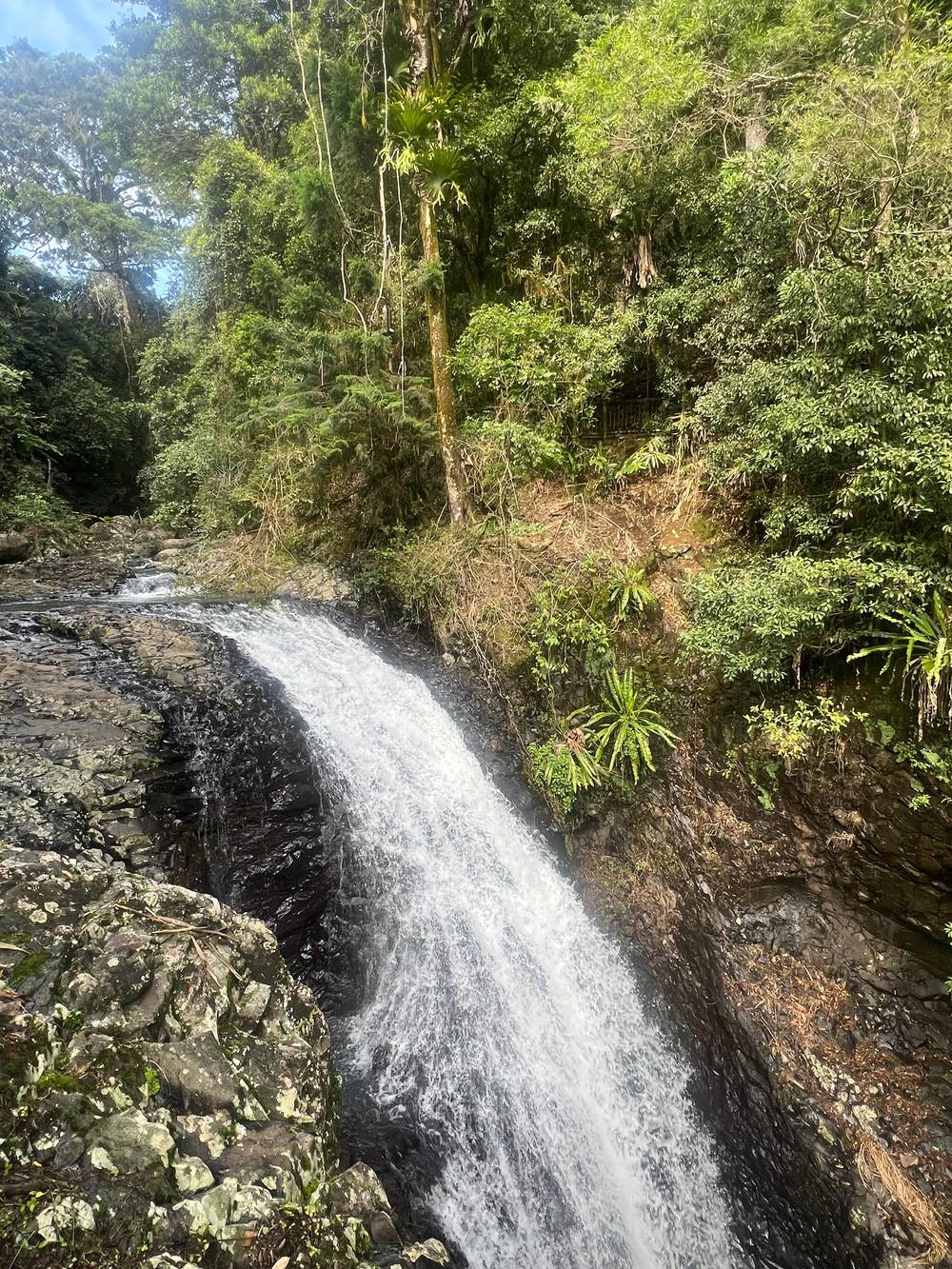
That rain is not a flaw in the park; it is the park. It feeds Purling Brook Falls, the Twin Falls circuit and the waterfall that pours through the roof of the Natural Bridge cave. The question is not whether you will see rain at Springbrook, but which kind of day you want: thundering water and mist, or crisp air and long views.
Month by month
Plateau rainfall and the season it falls in
| Month | Rain | Season | Expect |
|---|---|---|---|
| January | 290.5 mm1 | Summer9 | Full falls, storms |
| February | 286.3 mm1 | Summer9 | Humid, wet tracks |
| March | 316.2 mm1 | Autumn11 | The wettest month |
| April | 196.9 mm1 | Autumn11 | Strong falls, cooler |
| May | 184.9 mm1 | Autumn11 | Cooler walking days |
| June | 116.8 mm1 | Winter12 | Cold mornings |
| July | 86.0 mm1 | Winter12 | Crisp and clear |
| August | 72.7 mm1 | Winter12 | Dry, thinner falls |
| September | 67.1 mm1 | Spring13 | The driest month |
| October | 143.5 mm1 | Spring13 | Rain returns |
| November | 162.9 mm1 | Spring13 | Falls filling again |
| December | 251.4 mm1 | Summer9 | Wet season begins |
Mean monthly rainfall, Bureau of Meteorology station Springbrook Road (040607), elevation 697 m, all years since 1981.6,1
The wet season: December to March
Summer at Springbrook is lush, humid and wet. Australia's summer runs from December to February, and on the plateau those months average 251.4 mm, 290.5 mm and 286.3 mm of rain, before March tops them all at 316.2 mm.9,1 This is the season when the waterfalls are at their fullest and the forest smells of wet earth.
The rewards are worth the damp. The tourism body says that on summer nights the Natural Bridge section adds fireflies and glowing fungi to its glow worms, which makes a guided night walk at this time of year something special.7 Waterfalls fed by days of rain are the photographs most people come for. Go early in the day if you can: summer storms tend to build through the afternoon, and a downpour on the cliff tracks is no fun.
The cost is closures and slippery tracks. Destination Gold Coast tells walkers at the Natural Bridge to check park alerts in wet weather, because parts of the circuit may be closed for safety.10 Wear shoes with real grip, expect leeches on damp tracks, and keep a dry layer in the bag for the drive home.
Autumn and the cooling months: April to May
Autumn in Australia runs from March to May, and the official tourism body describes it as the season when temperatures cool.11,15 At Springbrook, the rain eases noticeably after March: the plateau averages 196.9 mm in April and 184.9 mm in May.1 The waterfalls are still strong, but you get more dry hours between showers.
For many visitors this is the sweet spot. The falls keep the energy of summer while the air dries out, which makes the climb out from the foot of Purling Brook Falls, part of a 4 km return walk of about two hours, far kinder.16 It is a good time for longer walks such as the Twin Falls circuit, which Destination Gold Coast describes as a 4 km loop that passes behind two waterfalls.17 With fewer storms in the afternoon, you can also stay longer at the lookouts and linger until the cloud breaks.
Do pack warmer clothes from late autumn on. Under the canopy dusk comes early, and Queensland warns that after-dark walking raises the odds of a trip, a fall or a wrong turn.4 Aim to be back at the car before sunset, and note when the sun goes down on your travel day. In the cooler months that can mean leaving the last lookout by mid-afternoon.
Pick by priority
When should you go for what you want
Name the one thing you most want to see and find the season for it.
If The biggest waterfalls
Late summer and March
March averages 316.2 mm of rain on the plateau.1
If The long view to Mount Warning
A clear winter day
Lookouts are often in cloud; pick a clear, smoke-free day.2,14
If Glow worms at their brightest
Any season but winter
Winter dims the colony to its faintest of the year.3
If Comfortable walking weather
April, May or September
Rain eases in autumn and September is the driest month.1
If Fireflies as well as glow worms
A summer night
Fireflies and glowing fungi appear on summer nights.7
Winter: cold, clear and dry
Australian winter runs from June to August.12 On the plateau these are the driest months, with 116.8 mm in June, 86.0 mm in July and 72.7 mm in August.1 Destination Gold Coast describes the Gold Coast winter as a swap of summer heat and humidity for crisp air and sunshine.20 On the range that usually means bright blue mornings, dry tracks and very few mosquitoes, which suits families and anyone who struggles with humidity.
Up on the range it is properly cold. The tourism body warns that a hinterland winter morning can drop into single digits, and suggests packing a puffer jacket and a beanie.8 For the views this is often the best season: the air is clearer, and the Best of All Lookout has its best chance of showing Mount Warning across the border.14
There are two trade-offs. The waterfalls run thinner after weeks of dry weather, and the glow worms at the Natural Bridge, although visible all year, give a much weaker display in the winter months.3 If the glow worms are the main reason for your trip, winter is the season to avoid. For everything else, a sunny winter day on the plateau, with cold air, long views and quiet tracks, is one of the best days the Gold Coast has to offer.
A year on the range
The Springbrook seasons at a glance
Dec to Feb
Wet summer
Months of 251.4 mm to 290.5 mm, with fireflies on summer nights.1,7
March
The wettest month
The plateau averages 316.2 mm, the peak of the year.1
April and May
Cooling autumn
Rain eases to 196.9 mm and 184.9 mm; the falls stay strong.1
Jun to Aug
Cold, clear winter
Mornings can drop to single digits; glow worms are weaker.8,3
Sep to Nov
Spring
September is driest at 67.1 mm; storms return by November.1
Spring: the driest month and the first storms
Spring in Australia runs from September to November, and the national tourism body sums it up as sunny days and cool nights.13,21 September is the driest month on the Springbrook plateau, with 67.1 mm, before the rain builds again to 143.5 mm in October and 162.9 mm in November.1 In other words, spring opens with the clearest weeks of the year and closes with the run-up to the wet season, so the same park can look quite different from one month to the next.
Early spring is a good compromise for walkers: firm tracks, comfortable temperatures and clear mornings. By late spring the first summer storms arrive and the falls start to fill again, which makes November a fine month for anyone who wants both water and walking weather. Spring is also a lively time in the forest: birds call loudly in the mornings, and the warmer nights bring the first fireflies back before summer.
Spring is also the season to watch for smoke. Destination Gold Coast advises visiting the lookouts on clear, smoke-free days for the best views.2 And when fire danger is high, a park fire prohibition or a total fire ban rules out every camp fire.19 Day visitors are rarely affected, but campers at The Settlement should check the fire status before packing firewood, and everyone should check park alerts on hot, windy days.18
Video
Walking behind Springbrook waterfalls after heavy rain
Frenzy Adventures on YouTube · Tap play to load the video; not before.
With the elevated position, temperatures in the Gold Coast Hinterland are significantly cooler than down on the coast.
Pack for the season
What to bring to the plateau
Any time of year3
In winter3
Is Springbrook National Park open, and when is it closed
Is Springbrook National Park open every day? There is no gate and no timetable, since Queensland keeps most of its parks open without set hours.4 What changes day to day is access. Heavy rain, storm damage or fire can close tracks or day-use areas for safety. So the honest answer is that the park is open, but any one walk on any one day might not be, and the only reliable source for that is the official park alerts page.
Hence the state's standing advice: look up the park alerts, the forecast and the roads before you head out.18 Destination Gold Coast repeats the advice for the Natural Bridge in wet weather, where some areas may be shut.10 Make it a habit on the morning of your visit. If the walk you came for is closed, the plateau usually has another option close by, such as the short stroll to the top of Twin Falls from the Tallanbana picnic area.22
Tours handle this for you. The operator of the half-day tour may alter or cancel parts of the itinerary because of weather or road closures, and the plateau stop includes the Canyon Lookout or the Goomoolahra Falls lookout only when time and weather allow. It is a sensible arrangement on a mountain that changes its mind quickly.
Best time of day for light, falls and glow worms
Time of day matters almost as much as the season. Mornings tend to be the coolest, which helps on steep tracks, while the soft late light of the afternoon suits photographs of the gorge walls. The tour on this site is a half-day outing of 5.5 hours, so check its start time when you book if the light at the lookouts matters to you.
For the glow worms you need full darkness. Destination Gold Coast suggests seeing the Natural Bridge by day for the cave waterfall, or after dark for the glow worms.23 Go with a guide, since Queensland discourages night walks in parks; an evening tour from Surfers Paradise covers it in 3 hours.4 Pick a night after rain if you can, when the air in the cave is still and damp.
Springbrook National Park temperature is the last thing to plan around. The mountain is cooler than the shore, so pack a jumper on hot days too, and expect a sharp drop once the sun slips behind the ridges.5 Check the sunrise and sunset times before you drive up, because the light goes early under the canopy.
FAQ
Questions answered quickly.
What is the best month to visit Springbrook?
April and May keep strong falls with less rain; September is the driest month at 67.1 mm.1
When is the wettest time at Springbrook?
March averages 316.2 mm on the plateau, the highest of any month.1
How cold does Springbrook get?
Destination Gold Coast says the hinterland can drop into single digits on a chilly winter morning.8
Is Springbrook National Park open at night?
Parks have no specific opening times, but walking after dark is not recommended.4
When are the glow worms best?
They are visible all year, with a much weaker display in the winter months.3
Will I see the view from the lookouts?
Mist often fills the viewpoints while the coast is sunny, so hope for a clear day without smoke.2
Can tracks close after rain?
Check park alerts in wet weather; some areas at the Natural Bridge may close for safety.10
Sources
- Bureau of Meteorology (bom.gov.au) · Monthly rainfall, Springbrook Road (station 040607) ↩
- Destination Gold Coast (experiencegoldcoast.com) · Best of All Lookout Track, Springbrook National Park ↩
- Destination Gold Coast (experiencegoldcoast.com) · Natural Bridge Circuit, Springbrook National Park ↩
- Queensland Government (qld.gov.au) · Outdoor adventures and activities ↩
- Destination Gold Coast (experiencegoldcoast.com) · 5 great reasons to visit the Gold Coast in winter ↩
- Bureau of Meteorology (bom.gov.au) · Monthly rainfall, Springbrook Road (station 040607) ↩
- Destination Gold Coast (experiencegoldcoast.com) · Natural Bridge, Springbrook National Park ↩
- Destination Gold Coast (experiencegoldcoast.com) · 5 great reasons to visit the Gold Coast in winter ↩
- Tourism Australia (australia.com) · Australia's seasons ↩
- Destination Gold Coast (experiencegoldcoast.com) · Natural Bridge Circuit, Springbrook National Park ↩
- Tourism Australia (australia.com) · Australia's seasons ↩
- Tourism Australia (australia.com) · Australia's seasons ↩
- Tourism Australia (australia.com) · Australia's seasons ↩
- Destination Gold Coast (experiencegoldcoast.com) · Best of All Lookout Track, Springbrook National Park ↩
- Tourism Australia (australia.com) · Australia's seasons ↩
- Destination Gold Coast (experiencegoldcoast.com) · Best Waterfalls on the Gold Coast ↩
- Destination Gold Coast (experiencegoldcoast.com) · Explore Springbrook on the Gold Coast ↩
- Queensland Government (qld.gov.au) · Park alerts and warnings ↩
- Queensland Government (qld.gov.au) · Camp fires, fuel stoves and barbecues ↩
- Destination Gold Coast (experiencegoldcoast.com) · 5 great reasons to visit the Gold Coast in winter ↩
- Tourism Australia (australia.com) · Australia's seasons ↩
- Destination Gold Coast (experiencegoldcoast.com) · Springbrook Plateau, Springbrook National Park ↩
- Destination Gold Coast (experiencegoldcoast.com) · Explore Springbrook on the Gold Coast ↩